Deep Work
Deep work is the ability to focus without distraction on a cognitively demanding task. Built on structure rather than willpower, it reserves unbroken blocks of time, shuts out interruptions, and spends them on the one thing that requires real thinking.
What It Is
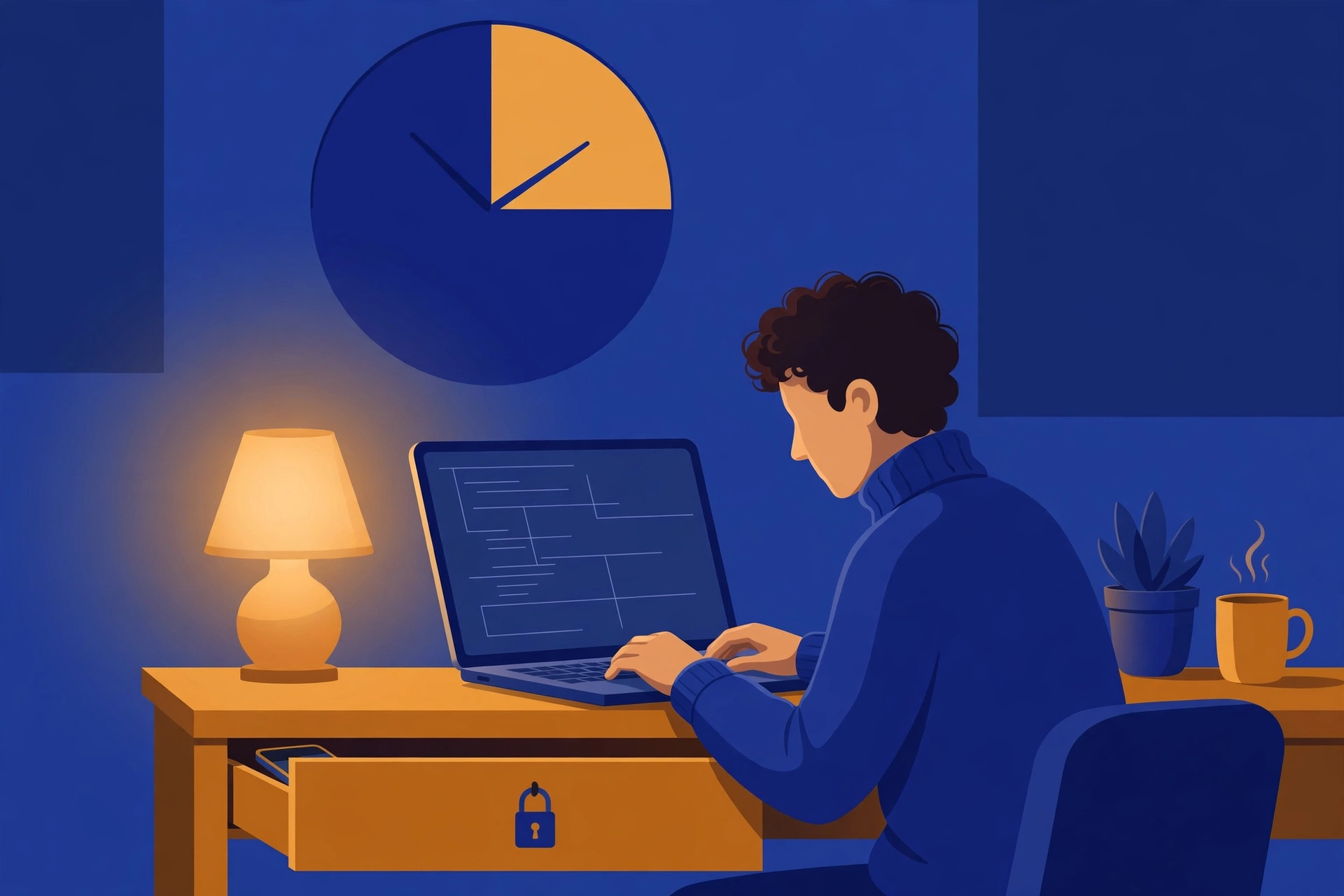
Deep work is the ability to focus without distraction on a cognitively demanding task. It is not about working longer hours or pushing through with willpower. It is about structure: carving out the clearest hours of the day, shutting out every interruption, and doing one thing that requires real thinking.
Cal Newport's argument in *Deep Work* is simple: the ability to do deep work is becoming increasingly rare at exactly the same time it is becoming increasingly valuable. Rare, because instant messages, meetings, and feeds chop the workday into fragments. Valuable, because the work that actually matters — writing difficult code, thinking through a complex design, making a hard decision — can only happen in a deep state. Shallow work can be replaced. Deep work cannot.
Deep work is not "working long hours" and it is not "heads-down grinding." It has three marks: the task itself demands high concentration and cannot be done while chatting; there is no switching during the session, one thing at a time; and the output is measurable — chapters written, features shipped, problems solved — not the feeling of having been busy all day.
Origins and Key Figures
- Cal Newport (2016): Author of *Deep Work* and a computer science professor at Georgetown University. The book lays out four rules: work deeply, embrace boredom, quit social media, and drain the shallows. Newport practices what he preaches: he does not use social media, does not answer email during the day, and still maintains an extraordinary academic output.
- Carl Jung (early 20th century): The psychologist built the Bollingen Tower on Lake Zurich — no electricity, no running water — where he retreated alone to write. Newport holds him up as an early model of deep work: valuable thinking often requires deliberately stepping away from the world.
- Bill Gates (1990s to today): Twice a year, Gates takes a "Think Week" — alone in a lakeside cabin with books and papers, a full week of reading and thinking. Several of Microsoft's early strategic decisions came out of those isolated weeks.
- Sophie Leroy (2009): A researcher at the University of Minnesota who identified "attention residue": after switching from task A to task B, part of your attention stays stuck on A, and your performance on B suffers. Her experiments put a real price on constant switching.
- Newport's later books: *Digital Minimalism* (2019) is about reclaiming attention fragmented by phones; *Slow Productivity* (2024) is about producing high-quality work without overload. Together the three books make one argument: attention is the knowledge worker's scarcest resource, and managing attention is managing output.
How to Use
- Pick tasks worth going deep on: Not all work deserves deep work. List the 1 to 3 highest-value tasks for the week — writing core code, finishing a design, completing a key chapter. The test is simple: would finishing this change your output in a visible way?
- Block fixed time every day: Put 1 to 2 ninety-minute blocks on your calendar, preferably in the morning. A time block is an appointment, not a wish: treat it as a meeting that cannot be cancelled, and tell colleagues you will not reply to messages during it.
- Design a starting ritual: A fixed opening routine helps your brain switch into focus fast. For example: make a coffee, silence your phone, open the document, write down exactly what this 90 minutes should produce. The more fixed the ritual, the faster you get into state.
- Shut out every interruption: During a block, silence your phone and put it out of sight, turn off email and chat notifications, and keep only the tabs the current task needs open in your browser. Interruptions you cannot resist by willpower must be removed by the environment in advance.
- Work in 90-minute units: One deep work session works best at about 90 minutes, followed by a 15 to 20 minute break. Ninety minutes follows the rhythm of attention: shorter and you never get into state, longer and efficiency falls off a cliff.
- Run a shutdown ritual: At the end of the workday, spend 5 minutes on three things: confirm where today's tasks stand, list tomorrow's top task, and say "shutdown complete." The ritual stops your brain from running background worry and keeps attention residue from following you home.
- Embrace boredom to train attention: When you are not working, do not reach for your phone at once. Standing in line, waiting for a bus, walking — let your mind stay empty. Newport's point is that attention is a muscle: scrolling in every idle moment trains it to stay mildly distracted, and then it cannot focus when deep work asks it to.
- Measure deep hours every week: Track how many deep work hours you log each day and review the total weekly. The goal is not more and more, but steady: for most knowledge workers, 3 to 4 hours of deep work a day is already a high level.
Case Study
This is the full story of a backend engineer who spent 8 weeks changing how he worked, from fragmented to deep.
Background: Li Wei, 32, a backend engineer at a 200-person SaaS company, owns the core billing module. In March 2025, his workday was cut into more than 20 fragments by meetings, instant messages, and code review requests, and his coding was interrupted mid-thought again and again.
Constraint: The team had a daily standup and two cross-team syncs he could not skip; production incidents could page him at any time; the project schedule was already full, with no chance of "a free month."
Diagnosis: He tracked his own work for a week: on average only 1.5 hours of deep work a day, 47 context switches, interrupted once every 11 minutes; a medium-complexity feature took 11 days from start to release, most of it waiting and rework. The problem was not ability. It was how he worked.
Action: He agreed with his tech lead on a daily 9:30 to 11:00 no-interruption block, except for real emergencies; he also batched email and chat replies into three daily windows — 11:30, 16:00, and 17:30.
Phase: Phase 1 (weeks 1 to 2) did one thing only: record baseline data and protect one 90-minute block each morning. Phase 2 (weeks 3 to 4) added the starting ritual and shutdown ritual, and the blocks went up to two a day. Phase 3 (weeks 5 to 8) batched fragmented work, pushed back or merged meetings that could be moved, and started a weekly review of deep hours.
Result: After 8 weeks, average deep work rose from 1.5 to 3.2 hours a day; the release cycle for a medium feature fell from 11 days to 6; code reviews passed on the first round far more often, with rework comments down by about a third.
Metric: He tracked four metrics: daily deep work hours, context switches, feature release cycle, and review rework rate. All four were recorded weekly, and a change only counted once it held steady for four weeks.
Retrospective: The biggest lesson was not any single trick but the order — diagnose first, then act. If he had simply worked overtime, the output would not have changed and the problem would still be there. The weak spot was incident weeks: blocks got shattered, and it took two or three days to recover. He later set shorter 45-minute blocks for those weeks.
Transfer: The same approach moves to any knowledge work: a writer writes for 90 minutes each morning before handling admin; a product manager separates spec reviews from writing time; a researcher puts paper reading and coding in different blocks. The method is not the point. The order is: reserve unbroken time first, then start working.
Strengths and Limitations
Strength: Deep work produces high-quality output, and it gets faster with practice — the time to get into state drops from 30 minutes to 10. It also brings a sense of accomplishment: at the end of the day you can say exactly what you finished.
Limitation: It needs unbroken time, which is hard in roles whose calendars are sliced up by meetings. It only fits certain tasks; repetitive, process-driven work gains nothing from it. And it is slow to pay off, usually taking 3 to 4 weeks of steady practice before the change shows.
Risk: The biggest risk is turning deep work into self-deception — shutting the door for a day of "deep" work on something nobody needs. The second is over-isolation: missing collaboration and information that genuinely matter.
Boundary: Deep work answers "how to do one thing well." It does not answer "what to do." It can raise output per hour, but it cannot fix a wrong direction or a broken collaboration process.
Not suitable: Roles that demand constant response (customer support, on-call operations), management work that is mostly coordination, and firefighting jobs with deadlines measured in days do not fit the full routine.
Mitigation: When time is tight, compress rather than quit: protect one 45-minute block a day first. In collaboration-heavy roles, agree on "no-interruption hours" with the team instead of disappearing alone. Check every two weeks whether output is really improving, so the practice does not become a ritual for its own sake.
Trade-off: Deep work and responsiveness are always in tension. More unbroken time means slower replies to messages — but fast replies usually buy only shallow output. The test is the cost of getting it wrong and the value of the output: the more the output depends on thinking, the more time is worth reserving first.
Common Questions
Q: How many hours of deep work a day is enough?
A: For most knowledge workers, 3 to 4 hours a day is already a high level — roughly Newport's own amount. Beginners can start with one 90-minute block a day and add more after two steady weeks. The point is consistency, not one heroic 8-hour day.
Q: My job depends on instant messaging. What can I do?
A: Deep work does not require being offline all day, only offline during the blocks. Batch replies into fixed windows — say three times a day, 20 minutes each. Tell colleagues your block schedule in advance; most people understand. If something is truly urgent, they will call.
Q: How is deep work different from the Pomodoro Technique?
A: Pomodoro is a time-management trick that uses 25-minute segments to fight procrastination. Deep work is a way of working whose core is unbroken time plus a cognitively demanding task. The two stack well: you can run three pomodoros inside one 90-minute block to keep rhythm.
Q: I cannot concentrate. Is my willpower too weak?
A: Not necessarily. Attention is a muscle that needs training, and it also needs the right environment. Check three things first: whether you slept enough, whether your blocks are fixed, and whether your phone is out of sight. Most people fail to focus because the environment is full of interruptions, not because their willpower is broken.
Recommended Resources
- Cal Newport, *Deep Work* (2016): The full source of the four rules — time blocking, the shutdown ritual, and embracing boredom all come from this book.
- Cal Newport, *Digital Minimalism* (2019): A 30-day digital declutter to reclaim attention fragmented by phones.
- Cal Newport, *Slow Productivity* (2024): Producing high-quality work without overload — do fewer things, and do them well.
- Sophie Leroy, "Why Is It So Hard to Do My Work?" (2009): The original paper on attention residue, showing the real cost of switching tasks.
- Bill Gates' Think Weeks: Twice a year, a week alone with books and papers — a famous deep work practice.
- Carl Jung's Bollingen Tower: The lakeside stone house where Jung retreated to write, an early real-life model of deep work.
Related Methods
Core Quote
The ability to perform deep work is becoming increasingly rare at exactly the same time it is becoming increasingly valuable in our economy. — Cal Newport