Root Cause Analysis
Root Cause Analysis (RCA) is a systematic discipline for tracing problems past their surface symptoms, down the chain of causation to the root cause whose removal prevents recurrence — from Toyota's 5 Whys to the postmortem rituals of internet giants.
What It Is
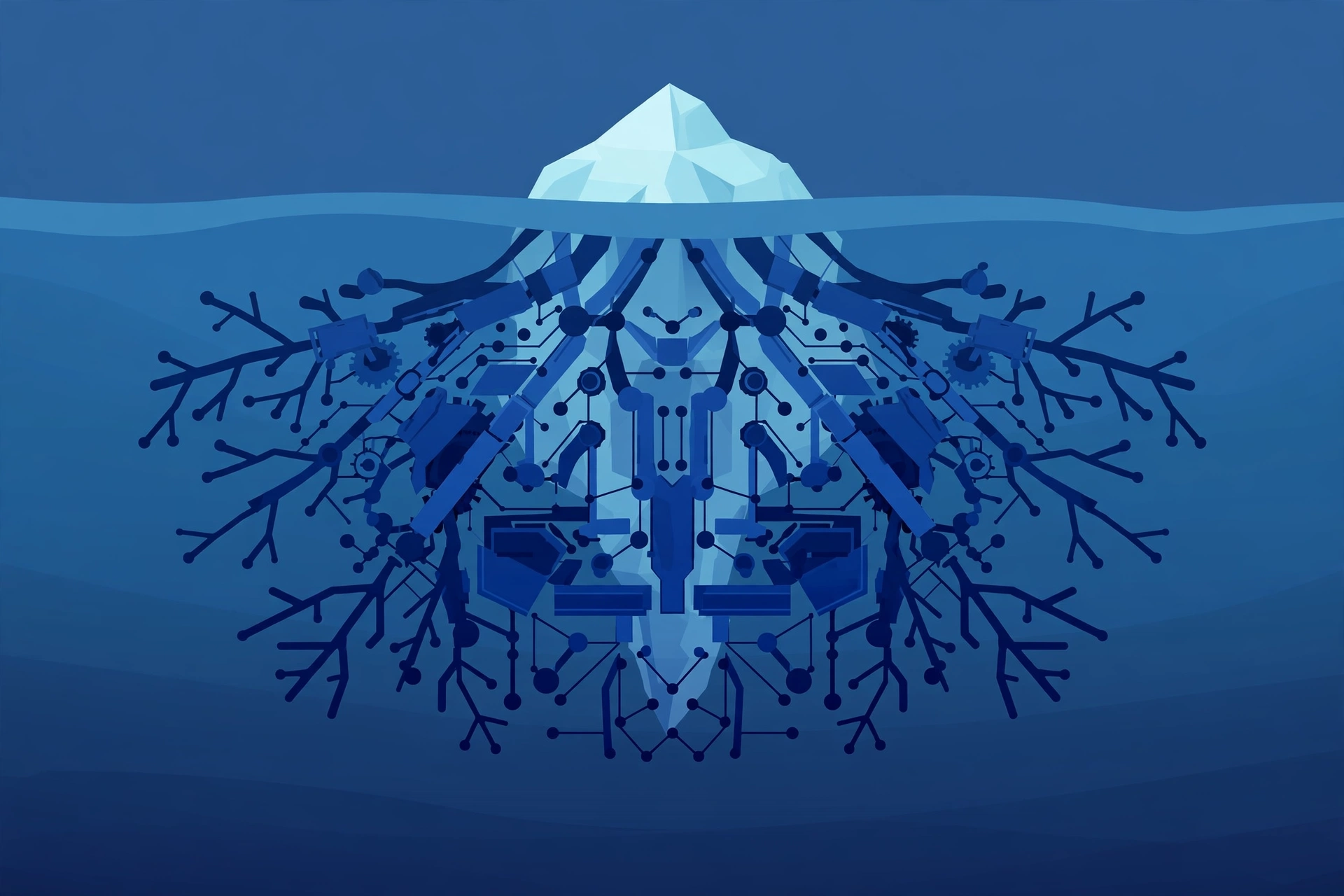
Root Cause Analysis (RCA) is a systematic "follow the thread" discipline: when something goes wrong, you don't stop at fixing the surface symptom. Instead, you trace the chain of causation downward, layer by layer, until you find the one cause that — left unaddressed — guarantees the problem will come back. Then you act on that root cause. RCA doesn't worship a single tool; it's a discipline of thinking. The 5 Whys, the fishbone diagram, and fault trees are simply its most common weapons.
Origins and Key Figures
The thinking behind RCA comes from the Toyota Production System. Taiichi Ohno institutionalized the "5 Whys," requiring engineers to ask "why" five times for any anomaly, driving past operator error down to the process defect. Around the same time, quality scholar Kaoru Ishikawa invented the fishbone (Ishikawa) diagram, visualizing possible causes across dimensions like people, machines, materials, and methods so that team-wide brainstorming would miss nothing.
RCA was later adopted by aviation, healthcare, and nuclear power — industries where failure is not an option — becoming the standard for incident investigation. It then moved into the internet industry as the standard Postmortem ritual. From Toyota's factory floor to the data center, the tools changed; the question never did: but why?
How to Use
- Define the problem, pin down the symptom: Write one sentence describing what happened, with observable facts (time, scope, impact) — not guesses. Don't say "the system is unstable"; say "Nov 2, 14:00–14:40, payment API P99 latency rose from 200ms to 8s, error rate 12%."
- Freeze the scene, collect evidence: Capture evidence before memory fades — logs, monitoring graphs, change records, witness accounts. Evidence records facts only, never judgments about whose fault it is.
- Draw the causal chain, dig down from the symptom: Expand with 5 Whys or a fishbone diagram. Every "why" must be answered with a verifiable fact, not speculation. When the chain branches, investigate in parallel; don't conclude early.
- Verify the root cause — don't just "feel" it: Challenge each candidate root cause — if it were truly the cause, the symptom should be reproducible; remove it, and the problem should disappear. A "root cause" that can't survive verification is merely a suspect.
- Act on three levels: corrective action on the root cause (prevent recurrence), mitigations on the symptom (stop the bleeding first), and preventive action on the process (make similar problems hard to happen). Every action needs an owner and a deadline.
- Write the retrospective, build organizational memory: Document the analysis in a postmortem and archive it in the knowledge base. The greatest value of RCA isn't solving this one incident — it's making sure the organization never pays tuition twice.
Case Study
Background: A fictional case. "CloudSpruce" is a SaaS company offering collaborative online documents. One Tuesday afternoon, customer support was flooded with complaints: documents kept spinning when saving, and unsaved content was occasionally lost. Monitoring showed API error rates spiking from 0.03% to 8%, lasting about 40 minutes before recovering on its own.
Diagnosis: The on-call engineer's first instinct was "the database is down," but the primary database was perfectly healthy. The team launched an RCA: first, pin the symptom — errors were concentrated on the "save document" endpoint, all from users in one region. Why: regional traffic had been routed to a newly launched edge node. Why did the new node fail: its local cache configuration was inconsistent with other nodes. Why the inconsistency: last week's config rollout script had silently failed on the new node, and the health check only verified the process was alive — never the config version.
Action: Three levels of measures in parallel. Stop the bleeding: route regional traffic back to the old nodes. Correct: fix the rollout script's error handling so failures become visible. Prevent: add config-version consistency checks to health checks, and roll out config changes via canary releases.
Result: Traffic was rerouted within 2 hours, the script fixed the same day, and canary releases went live within a week. Zero recurrence of config drift in the following three months.
Retrospective: The most expensive lesson wasn't technical — it was "silent failure." The script failed and nobody knew. The team wrote "every automation failure must alert visibly" into its engineering standards. This is where RCA pays off: without digging down to the silent script failure, the next config change would have caused the same outage.
Strengths and Limitations
Strengths: RCA's greatest strength is that it cures rather than numbs. It forces teams through the surface with evidence chains instead of gut feelings — solve once, prevent a class of problems. Archived postmortems become the organization's immune memory.
Limitations and boundaries: RCA has clear boundaries. First, it's a reactive method — unsuitable where proactive prevention is needed (that's FMEA's territory). Second, it assumes relatively clear causation; in highly complex chaotic systems, there may be no single "root cause" at all — only interacting factors. Third, it's hungry for evidence quality; with incomplete logs and missing monitoring, analysis degrades into a witch hunt.
Risks and mitigation: The biggest risk is RCA degenerating into a blame game — once it becomes about finding a scapegoat, nobody tells the truth and the evidence chain breaks. Mitigation: build a blameless postmortem culture — no names in the document, only roles; leaders go first in admitting their part. Another common risk is analysis paralysis — spending weeks hunting the "ultimate root cause" without shipping countermeasures. Mitigation: timebox it — mitigations within 24 hours, root-cause closure within two weeks.
Common Questions
Q: How many "whys" are enough? Must it be exactly five?
A: No. "Five" is just a rule of thumb. The actionable stopping rule: stop when the answer shifts from "a person / a single action" to "a missing process or mechanism" — because at that point your countermeasure can land on process improvement.
Q: Fishbone diagram or 5 Whys — which should I use?
A: It depends on the shape of the problem. How to choose: for a single symptom with a fairly linear causal chain (e.g., one production outage), dig deep with 5 Whys; for a complex symptom with suspects scattered across dimensions (e.g., "rising customer churn"), first use a fishbone to enumerate dimensions like people, process, product, and external factors, then drill each branch with 5 Whys. They're often used together.
Q: We found the root cause, but fixing it costs too much. What now?
A: That's the norm, not the exception. Actionable advice: layer your countermeasures — ship cheap mitigations first to stop the bleeding (e.g., add monitoring alerts), schedule the root-level fix (e.g., a refactor), and have an owner explicitly sign off on the accepted residual risk. The bar: as long as residual risk is explicitly recorded and accepted, it's a qualified RCA. The real failure is pretending it's solved.
Q: Is RCA worth it for small problems?
A: It depends on recurrence cost. Actionable advice: score quickly with "impact × probability of recurrence" — P0 outages, customer money loss, compliance risks always deserve one; an occasional minor UI glitch just gets fixed. The key move: even without a full RCA, log the symptom and the fix; three similar issues trigger a formal analysis.
Recommended Resources
- *Toyota Production System* (Taiichi Ohno): the origin of the 5 Whys; essential for understanding the "go and see" mindset.
- Google's SRE series (*Site Reliability Engineering*): Chapter 15 on postmortem culture — the field manual for RCA in the internet industry.
- Kaoru Ishikawa's *Introduction to Quality Control*: the fishbone inventor explaining cause-and-effect diagrams himself.
Related Methods
Core Quote
Treating the headache only guarantees the problem returns; dig to the root cause for a lasting cure.